
How Mega SEO Works

Experts lead. Agents execute. Humans stay accountable.
A specialist AI agent researches and drafts the work, a human strategist reviews it against your account’s approval settings, and only then does it publish, launch, or send. That loop runs across four agents (search and AI visibility, paid ads, website and landing pages, and lead conversion), and you decide how tight the review is on each one
The rest of this page walks through that loop stage by stage: what each agent actually does, how the human sign-off works, why pairing agents with strategists produces a different result than automation running alone, and where this kind of system fits now that search itself has split across Google, AI Overviews, and answer engines such as ChatGPT and Perplexity.
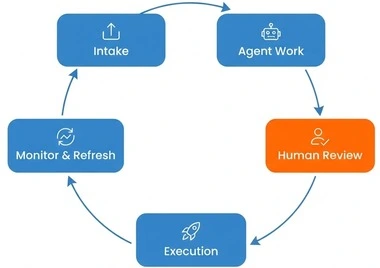
The loop behind every deliverable
Everything Mega SEO produces, whether that is a blog article, an ad campaign, a landing page, or a qualified lead, moves through the same five stages.
- Intake. Your business data, existing content, brand voice, and goals go in first. The agents work from your site, your competitors, and your account settings, not a generic template.
- Agent work. The relevant agent researches the task (keywords, ad auction data, page performance, or an inbound message) and produces a draft: an article, an ad set, a page change, or a qualification response.
- Human review. A strategist checks the draft against your governance setting. Depending on the mode you chose, that review happens before every publish or only when the agent flags something outside its normal range.
- Execution. Approved work goes live: to your CMS, your ad accounts, your website, or your lead’s inbox.
- Monitoring and refresh. The agent keeps watching what it shipped. Rankings, click-through rate, cost per lead, and conversion rate all feed the next round of work, so a published page or a running campaign is never really finished
That loop is what “Experts lead. Agents execute. Humans stay accountable.” means in practice. The agents handle the repetitive, data-heavy parts. The strategists reviewing that work average 10-plus years in performance marketing, and they carry the judgment calls, and the accountability, for what goes out under your name.
The four agents, and what each one actually does
Search & AI Visibility Agent (SEO, AEO, GEO)
This agent handles the work that used to sit entirely on an SEO team’s desk: keyword and topic research, competitor gap analysis, drafting and structuring content, internal linking, on-page technical checks, and schema markup. Search results now include Google’s AI Overviews alongside the traditional ten organic results, and a meaningful share of research now happens directly inside ChatGPT, Perplexity, Claude, and Gemini.
So the same agent also structures content for answer engine optimization (AEO) and generative engine optimization (GEO): self-contained answers, clearly named entities, and sourcing these systems can cite. How much of each (SEO, AEO, or GEO) a given business needs is not fixed. A local, transactional business leans harder on classic SEO; a business-to-business software company typically needs a mix of all three; a publisher leans toward AEO.
Paid Ads Agent (Google & Meta)
This agent builds and runs paid campaigns across Google and Meta: audience targeting, budget allocation, bid strategy, ad copy and creative variants, and ongoing optimization based on what is actually converting. Every spend change and every new campaign launch routes through your account’s approval setting before it touches a live budget.
Website & Landing Page Agent (CRO)
This agent audits your site and existing landing pages, then builds, tests, and ships changes aimed at conversion: page structure, copy, calls to action, load speed, and mobile usability. It is the agent responsible for turning the traffic the other agents generate into something that actually converts once a visitor lands.
Lead Conversion Agent (24/7 lead qualification)
This agent responds to inbound leads as they arrive, at any hour, asks qualifying questions, and routes anything that meets your criteria straight into your sales process. It closes the gap between a form submission at eleven at night and the first human reply the next morning, a gap where, in most businesses, leads go cold.
How much control you actually keep
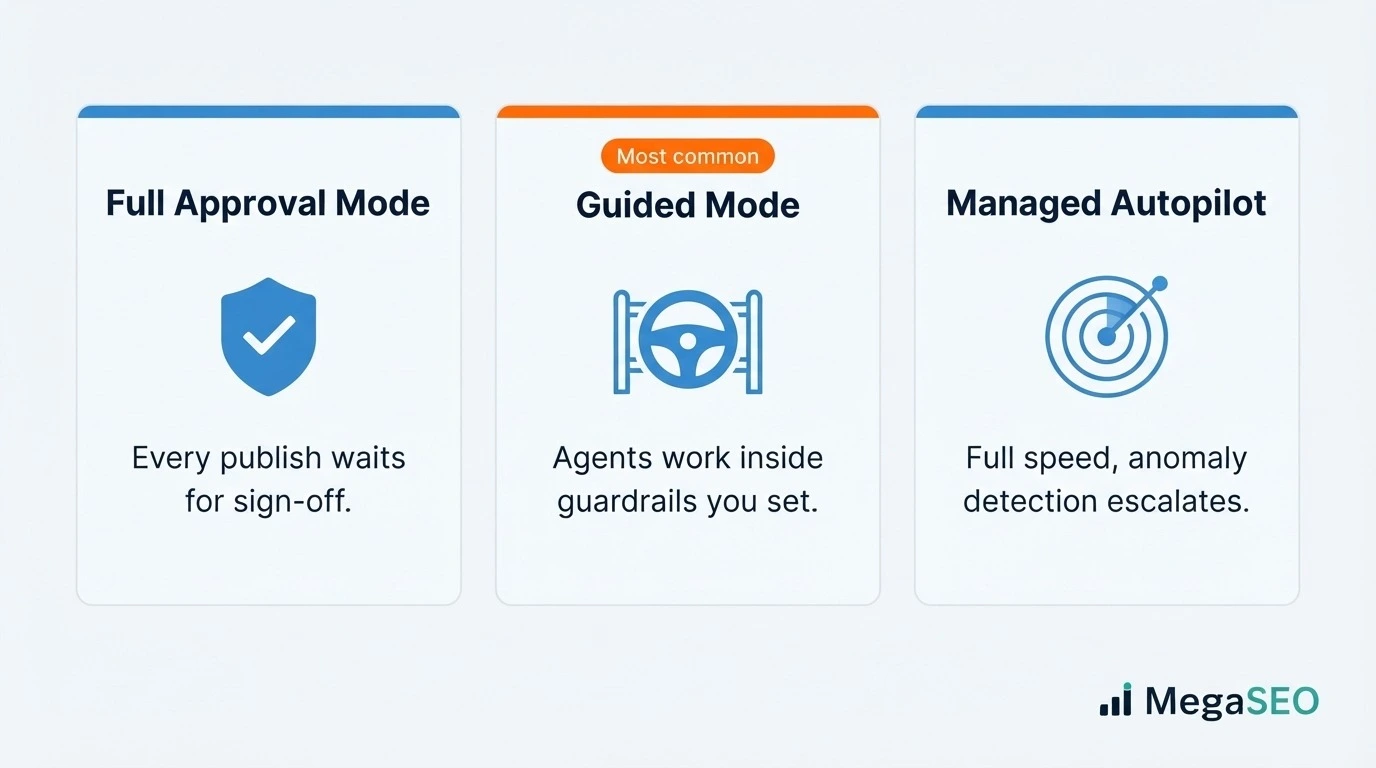
Mega SEO runs on three governance modes, and you choose the one that fits your business and your risk tolerance. The easiest way to see the difference between them is to watch one in action on a live demo.
- Full Approval Mode. Every piece of work, every campaign change, and every publish waits for your sign-off. This is the default for new accounts and the standard for regulated industries such as legal, healthcare, and finance.
- Guided Mode. The most common setting. Agents work autonomously inside guardrails you set, and a strategist steps in for anything that falls outside those guardrails or that the agent flags as an exception.
- Managed Autopilot. Agents run at full speed within the scope you have approved, and an anomaly-detection layer pauses the work and escalates to a human strategist the moment something looks off.
Nothing charges a card, shifts an ad budget, or publishes to your live site without your account being configured to allow it. That holds in every mode, not only Full Approval.
Why the agent-plus-strategist combination changes the outcome
Raw AI output and AI output a strategist has reviewed and edited are not the same product, and the evidence for that gap is public, not a Mega SEO talking point. Google’s own guidance on AI-generated content says the technology can help with research and structure, but that a genuine point of view and first-hand experience are what separate content worth ranking from content that is not. Google’s scaled content abuse policy is explicit that pages built mainly to manipulate rankings violate the policy however they were produced, by a person or by a tool.
An Ahrefs study of one million pages and 100,000 search results, published June 2026, found that 54.7% of pages ranking in the top ten had under 20% detected AI content, and that pages under 50% AI content accounted for 82.2% of top-three rankings. None of that means AI-assisted content cannot rank. It means the content that ranks tends to carry a real editorial layer, which is the same principle built into every Mega SEO governance mode above the lightest-touch setting.
Why the ranking picture is bigger than one search box now
A page ranking in Google’s top ten organic results used to be the finish line. It now works more like a prerequisite. Google’s AI Overviews tend to cite pages that already rank well for the underlying query, but Ahrefs’s own citation-overlap study found the share of AI Overview citations coming from that organic top ten fell from about 76% in July 2025 to about 38% by March 2026. A meaningful part of that gap is citations happening for sub-questions a page never explicitly targeted, one reason the Search & AI Visibility Agent maps and answers the questions surrounding a topic, not only its head keyword.
Google has started reporting on this layer directly. Its Generative AI performance report inside Search Console, in beta and rolled out worldwide on August 31, 2026, shows impressions, pages, countries, and devices for how a site performs inside AI Overviews and AI Mode, alongside the standard organic report.
None of this comes with a guarantee. No agency, tool, or agent, Mega SEO included, can promise a ranking or a revenue number, because none of us sets Google’s algorithm. What the system above is built to do is put a business in the strongest defensible position across both the traditional result and the AI-generated one, and keep it there as both keep shifting.
Where this is heading
Four in ten marketing agencies already run at least one AI agent in production. Gartner’s own worldwide AI spending forecast puts agentic AI investment at $201.9 billion in 2026, on a path to overtake chatbot spending by 2027 (several independent analyst firms size the standalone agentic AI product market lower, at roughly $7 to $8.5 billion for 2025 to 2026, a difference that comes down to what each firm counts). Separately, Gartner projects that a third of enterprise software applications will include agentic AI by 2028, up from under 1% in 2024.
The direction is not in question. What is still being worked out, across every serious platform in this space, is how tightly the human layer stays coupled to the agent layer as the agents get more capable, which is exactly the governance question the three modes above are built to answer, not sidestep.
Frequently asked questions
How Mega SEO Works
Everything you need to know about our AI agents, senior strategist oversight, customization and operating model
See it running on your own site
The clearest way to see this loop is to watch it work on a real business. Book a free 30-minute demo to see the four agents research and draft against your own site, or go straight to pricing to see which combination of agents fits your budget. For a closer look at how the agents adapt to your specific business type, see how Mega SEO customizes content.